Monday, September 21, 2020

Two Common Tangent Lines to Two Functions! (2.1 #77)


Finding a slope of a tangent line on one function, but can we find a common tangent line to two functions?  How about 2 Common tangent lines? It takes some algebra together with our calculus, but it can be done!

When is a function not differentiable?(2.1 #80)

 When is a function not differentiable? (p 109 (2.1) number 80


 A function may not have a derivative.  After all slope is rise over run, and if it is a vertical line, it will have no slope.  Here we have an example that has no slope at x=0, since the slopes from the left and the right do not agree (so the limit does not exist, so neither does the slope!

Integration by Parts: Tablular style (8.2 #17)


Integration by Parts: Tablular style (8.2 #17)


An example of a case where integration by parts has more then one step, so I demonstrate the tabular method of integration by parts.

Welcome back to School 2020


 Welcome back to school - remote style!

Thursday, September 10, 2020

Intro to Derivatives (Ch 2.1)


Introducing the idea that a slope of a curve depends on the value of x... so we call the slope formula a derivative... The limit of the slope of a secant line is how we get this major topic started!

Wednesday, September 9, 2020

Some Ch P and Chapter 1 Review Questions (P2. 69, #79) (P.revw #39) (1.3# 79)(1.4 #84, 93)


 A few problems are explained, including tangent lines, and the Intermediate Value Theorem (IVT).

The arc length of a predator chasing prey (7.4 #65)

 Using the arc length integral we can show that a predator can travel twice the distance in the same amount of time!


Monday, September 7, 2020

Derivatives of Common Functions Review (Chapter 8 Basics)


A review of the derivatives of the basic functions, with a derivation of a few of them.

Answer it yourself before you watch.

Saturday, September 5, 2020

One Sided, "Type 2" Limits (1.5 #37,49)


Type 2 limits are the type that when you substitute the number that x is going towards, you get a fraction with a number in the numerator and a 0 in the denominator (->L/0).  The division by zero is associated with a vertical asymptote, so the limit will go to either positive infinity or negative infinity.

Continuity and the IVT (1.4, #63, 83, 85)


Using the requirements of Continuity, we can find a way to make a piece wise function continuous.  We also look at using the Intermediate Value Theorem (IVT) to prove the existence of a zero of a function on a certain closed interval.

Arc Length (7.4 #11)

An exact length of arc can be computed with the arc length formula, together with a bit of algebra, so the integrand is a product of factors where one factor is the derivative of the other so we can use "U-substition"

Exact Arc Length (7.4 # 19)


An exact length of arc can be computed with the arc length formula, together with a bit of factoring, recalling a^2+2ab+b^2 = (a + b)^2


Surface Area of a Function Rotated around an Axis


Knowing how to use calculus to find arc length helps us find the surface area a function rotated around an axis.  I use u-substitution to find the surface area of y=x^2 two different ways.

Wednesday, September 2, 2020

Continuity (1.4 #51, #53, and 1.5 #31)


Use limits to test Continuity! We check if the function exits, the limit from left and right exist, and they are all match! 

Saturday, August 29, 2020

Continuity and Limits (Section 1.4; 9, 13, 18, 20, 25)

 A function can be continuous at a point, and interval or everywhere.  We can tell if three things are required!


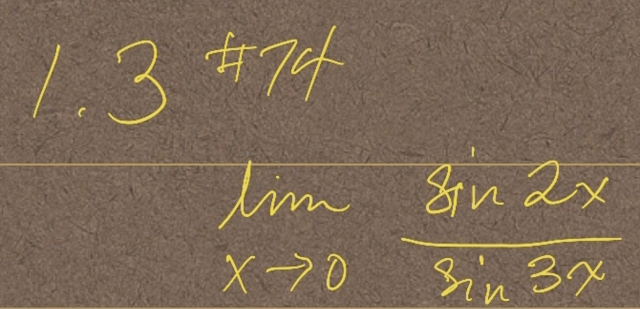
Using a Theorem to find a limit (1.3 #74)


 We can use Theorems together with algebra tricks to find limits that have the indeterminate 0/0 form.

Friday, August 28, 2020

Wednesday, August 26, 2020

More Algebra Tricks: The Conjugate (1.3 #52)

 Her we take advantage of (a+b)(a-b) = a2 - b 2.

to resolve an indeterminate form.


Using Algebra Tricks to Find a Limit (1.3 #51)

 If you substitute 4 for x, we get a 0/0 situation we call an indeterminate form which can resolved with some algebra tricks.


Summer Topic: Domains

Not all functions can take any number. The set of numbers that the function can accept is called a domain.  Here we review how to analyze a ...