A few problems are explained, including tangent lines, and the Intermediate Value Theorem (IVT).
Showing posts with label Chapter 1. Show all posts
Wednesday, September 9, 2020
Saturday, September 5, 2020
One Sided, "Type 2" Limits (1.5 #37,49)
Type 2 limits are the type that when you substitute the number that x is going towards, you get a fraction with a number in the numerator and a 0 in the denominator (->L/0). The division by zero is associated with a vertical asymptote, so the limit will go to either positive infinity or negative infinity.
Continuity and the IVT (1.4, #63, 83, 85)
Using the requirements of Continuity, we can find a way to make a piece wise function continuous. We also look at using the Intermediate Value Theorem (IVT) to prove the existence of a zero of a function on a certain closed interval.
Wednesday, September 2, 2020
Continuity (1.4 #51, #53, and 1.5 #31)
Use limits to test Continuity! We check if the function exits, the limit from left and right exist, and they are all match!
Saturday, August 29, 2020
Continuity and Limits (Section 1.4; 9, 13, 18, 20, 25)
A function can be continuous at a point, and interval or everywhere. We can tell if three things are required!
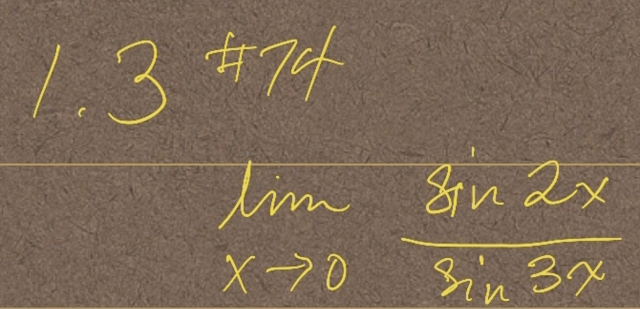
Using a Theorem to find a limit (1.3 #74)
We can use Theorems together with algebra tricks to find limits that have the indeterminate 0/0 form.
Friday, August 28, 2020
Wednesday, August 26, 2020
Using Algebra Tricks to Find a Limit (1.3 #51)
If you substitute 4 for x, we get a 0/0 situation we call an indeterminate form which can resolved with some algebra tricks.
Subscribe to:
Posts (Atom)
Summer Topic: Domains
Not all functions can take any number. The set of numbers that the function can accept is called a domain. Here we review how to analyze a ...
-
Not all functions can take any number. The set of numbers that the function can accept is called a domain. Here we review how to analyze a ...
-
An Accumulation function (4.4 p. 293# 67) An Accumulation function is a function that is a function of the accumulation of area under a cur...
-
Can a piece-wise function be differentiable? If it is continuous, and the slopes from the left and the right are the same, yes!